FAQs
Where does Montessori Education come from?
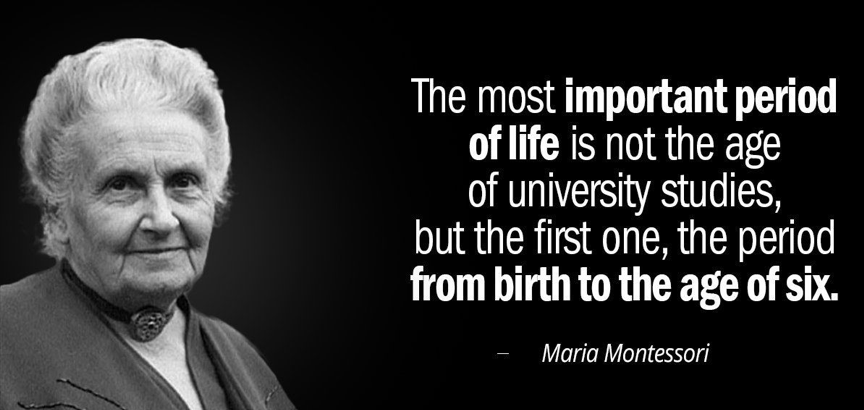
Montessori education was founded in 1907 by Dr Maria Montessori, the first woman in Italy to become a physician. She was also a scientist and teacher and documented her medical observations of the developmental stages of the brain like a scientist and applied this knowledge to the educational development of the child from infancy to adulthood. Her methods of education were based on her scientific observations of children’s learning processes. Guided by her discovery that children are able to absorb and learn from their environment as well as teach themselves if given the tools, Dr Montessori designed developmentally appropriate tasks and equipment. She offered them to children in a carefully prepared environment enabling children to choose from a number of appropriate activities and documented her observations as she witnessed the children thrive consistently. Now, nearly a century after Dr Montessori’s first ‘casa dei bambini’ (Children’s House) in Rome, Montessori education is found all over the world, spanning ages from birth to adolescence and has greatly changed the approach to the educational potential of the young child on a global level.
What is the difference between Montessori and traditional education?
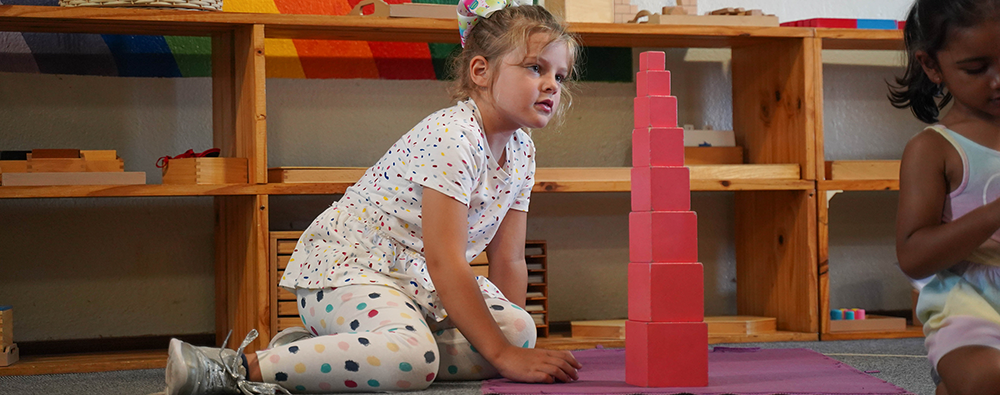
Montessori Education emphasizes learning through all of the senses, not just listening, watching, reading or following instructions. Children in Montessori classes learn at their own individual pace, and according to their own choice of activities from many options. Learning becomes an exciting process of discovery, leading to concentration, motivation, self-discipline and a love of learning. Montessori classes place children in three-year age groups (0-3, 3-6) – called VERTICAL GROUPING – forming communities in which older children spontaneously share their knowledge with the younger children.
| TRADITIONAL SCHOOLS | MONTESSORI SCHOOLS |
| Respect is based on the child respecting the adults unquestioningly. | Respect is based on the adults respecting the child first and modeling respectful behavior for the child to practice. |
| Educator is the centre of the classroom as a controller – teaching is controlled by a fixed curriculum. | The educator has an unobtrusive role in the classroom – teaching is collaborative and child centered. |
| Same age grouping where children are expected to perform at a level related directly to their age. | Mixed age grouping which encourages children to teach and help each other (vertical grouping with 3 year age span per group). |
| The educator acts as the primary enforcer of discipline and encourages self discipline. | Environment and method encourage self- discipline. |
| Instruction pace is usually set by the group norm and teacher – based on a set curriculum. | Children set their own learning pace over a 3 year cycle and are observed and guided by their teachers. |
| Errors are pointed out and corrected by the educator. | Children spot their own errors through self correcting materials and build confidence in their abilities to correct errors without interference. |
| Learning is motivated and reinforced externally by rewards and punishments. | Environment and equipment provide opportunities to experience satisfaction through practice and mastery. |
| Emphasis falls on intellectual development. | Physical, social, emotional, language and intellectual needs are equally important. |
| All children treated alike regardless of personal interest, particular talent and ability. | Differences and similarities in developmental stages as well as learning styles are acknowledged and accommodated. |
| Sensorial materials are stored in safety and taken out occasionally for demonstration. | Multi-sensory materials are available for physical exploration on open shelves daily. |
| Children are usually assigned their own chair/desk, are encouraged to work in silence and have limited time to move around inside. | Children can work independently or with each other and may choose where to work – at a table, on the floor, outside etc. They move around and talk with one another in collaboration and without disturbing those working individually. |
How do I know I am making the right decision?
This is a question that there is no fixed answer to and will vary for each individual family and child. We encourage all families who are considering choosing a Montessori preschool to research and gather as much information as possible to make sure that they are informed when making a decision that will work best for their child and is aligned with your family values. Remember that the Montessori philosophy doesn’t end at school and is most beneficial for the child when incorporated consistently into your home life as well. A good Montessori school will be your guide to the wonderful world of Montessori and will be open to working collaboratively with you for the benefit of the child.
When visiting Montessori schools – ask as many questions as possible! Some schools are inspired by the Montessori philosophy however not all Montessori schools are authentic in their application of the philosophy.
When visiting a Montessori school – ask questions such as:
- Do you have vertical age grouping?
- Do you have a comprehensive range of Montessori equipment?
- Are your staff Montessori trained and able to use the specialised equipment?
- Do you practice authentic Montessori education or are you a Montessori inspired school?
- How do you manage conflict and discipline?
- What is the ratio of children to teachers per environment?
- Please walk me through your daily routine?
Remember to trust your gut feeling/instinct. You know your child best and so know best what will work for him/her. There are many misconceptions about Montessori Education and its application in South African schooling. At The Cottage Montessori Radiokop, we encourage open and honest communication with the child’s best interests at the forefront of all that we do. We commit to providing as much information as possible to you from an experienced and accurate perspective in order to allow each family to make an informed decision on the best possible start to your child’s school foundation.
When should my child transition to 'big school' - Grade R or Grade 1?
Montessori, like many other developmentally informed approaches, is based on the understanding that certain aspects of development cannot be rushed by means of direct instruction. The Montessori pre-school program supports the development of skills that are refined as the child approaches the age of formal schooling over a three year period. A child who has experienced developmentally appropriate support in the early years is able to integrate and apply these skills to the demands of the conventional classroom when he or she reaches formal school going age. These skills are not limited to cognitive function only, but include social and emotional skills, physical development and control of movement, creative ability, self-direction and concentration, as well as the ethical and moral awareness which is prioritized in the Montessori approach.
Grade R:
Our Montessori curriculum for the 3-6 year age group includes the Grade R year, which is typically the year your child turns six. This year is crucial in your child’s development for many reasons. Our Grade R children are positioned as role models in the school, empowered to help and guide their younger peers. They gain confidence in their abilities and leadership skills throughout the year. The Grade R year also focuses on school readiness, allowing children to consolidate and build on their educational foundation, preparing them for the next step in their academic journey. With newfound confidence, leadership skills, and academic preparedness, our goal for each child who graduates from our 3-6 program (including Grade R) is that the child is not only fully prepared for ‘big school’ but is equipped with holistic developmental readiness (social, emotional, physical, cognitive and academic readiness) that will be carried with them for life!
Grade 1:
Children are deemed ready for Grade 1 once they have reached the appropriate level of development, assessed holistically and individually rather than in accordance with a timeline of required competencies or simply based on their age. The standardized Grade 1 age is generally accepted as the year that the child turns 7 HOWEVER this varies for each child dependent on when they were born in the year as well as their holistic readiness and thus it is encouraged that each child is individually assessed for developmental readiness rather than assumed to be ready based on their age.
Children who have benefited from the full three-year Montessori curriculum are typically very well prepared for Grade 1. They have had the opportunity to develop lifelong skills in all areas of their holistic development, which translate exceptionally well into any primary school setting, whether traditional or Montessori. We encourage you to discuss your child’s individual school readiness assessment and transition process with us. This collaboration will help ensure the best possible setting and transition for the next step in your child’s learning journey.
What is next for a Montessori Preschool graduate?
We have found that our children generally adjust quickly and easily to change and have a greater ability to adapt to any new environment whether traditional or Montessori aligned.
Research has also shown that Montessori children are well prepared for later life academically, socially and emotionally as the approach focuses on the holistic well being and preparation of the child in all areas. In addition to scoring well on standardised tests, Montessori children are often ranked above average on such criteria as following directions, handing in work on time, listening attentively, using basic skills, showing responsibility, asking questions, showing enthusiasm for learning and adapting to new situations.
In South Africa, Montessori Education has grown exponentially from a preschool focused curriculum to a holistic program incorporating preschool, primary and high school syllabi and we have the benefit of unlimited options for our graduates including both traditional and Montessori based education as the next step in their school career. The internationally recognized and acclaimed Cambridge program of education is often chosen by Montessori parents as the natural next step for Montessori students as the flexible educational opportunities complement one another in many ways.
Some famous Montessori graduates include Elon Musk, the founders of Google, the founder of Amazon, the founder of Wikipedia, Princes William and Harry and many, many more.